

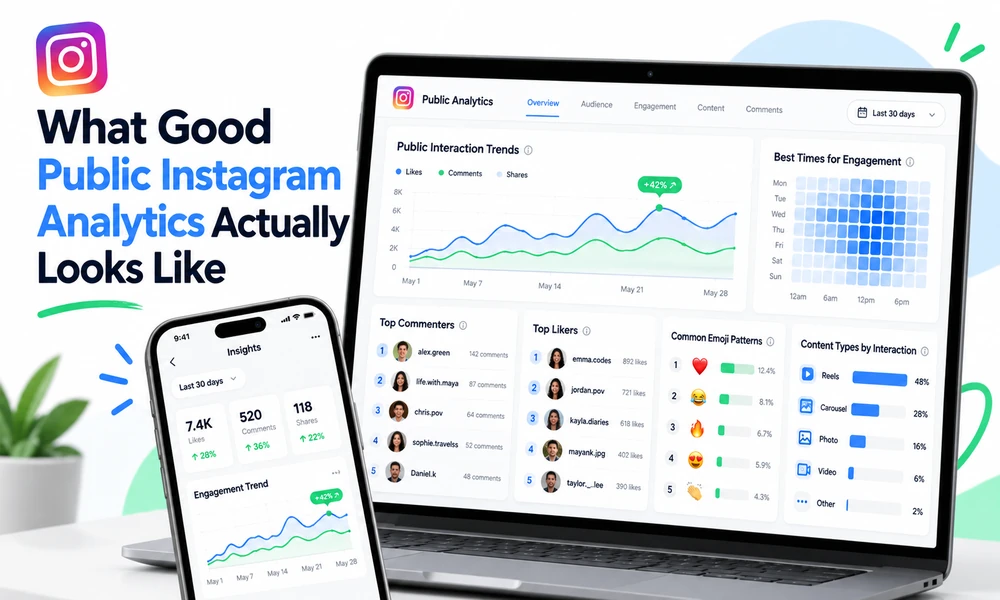
Most social-media analytics tools are built for marketers.
They tell you about reach, engagement rate, follower growth, and post performance.
SocialSleuth.xyz applies a similar idea to a very different question: what can public Instagram activity tell you when you are trying to understand a relationship pattern?
The useful part is not any single like, follow, comment, or emoji. It is the context around those events: what normally happens, which accounts keep standing out, whether several signals involve the same person, and whether the pattern lasts.
That sounds simple, but it matters because social media is unusually easy to overread. A 2025 longitudinal study of 322 young adults in romantic relationships found that social-media jealousy was associated with more electronic partner surveillance and with lower relationship satisfaction one year later. The study does not mean that checking social media causes relationship problems by itself, but it does show why a tool in this space should reduce guesswork rather than encourage constant monitoring.
There are four parts that make the difference.
1. You need to know what “normal” looks like first
You cannot spot a meaningful change if you do not know what usually happens.
That is true in analytics generally, and it is especially important with social activity, where the same behavior can mean very different things on different accounts.
Some people have the same five friends commenting on nearly every post. Others receive very little public engagement. One heart emoji might be completely routine for one person and genuinely unusual for another.
SocialSleuth.xyz starts by creating an initial activity snapshot from public Instagram activity. That gives you a picture of the accounts that already show up often, the people who comment regularly, recurring emoji behavior, typical interaction times, and the accounts that already sit in the visible inner circle.
Five comments from the same person might look important at first.
But if that person has been leaving four or five comments every week for months, the number itself is not especially informative.
Now compare that with someone who was almost invisible and suddenly comments three times in a few days.
The raw number is smaller, but the change is bigger.
This is one reason researchers who study social-media jealousy often focus on ambiguity rather than raw activity. A systematic review of research on social-media-induced jealousy found that ambiguous, context-poor information can encourage monitoring and suspicion. In other words, the problem is often not that people can see too little. It is that they see isolated pieces without enough context to know what those pieces mean.
That is why good public Instagram analytics needs context before it needs alerts.
2. One event is rarely enough
A like is one kind of signal.
A comment is another.
A new follow, recurring emoji, late-night interaction, or sudden jump into the top-engager group each tells you something slightly different.
SocialSleuth.xyz becomes more useful when those signals are looked at together rather than one at a time.
Take someone who becomes a new follow and then disappears.
Now compare that with someone who becomes a new follow, starts liking most recent posts, leaves a few personal comments, repeatedly uses the same emoji, and keeps showing up late at night.
Neither pattern proves anything about a private relationship.
But the second pattern contains more observable information because several independent public signals involve the same person.
This distinction matters because isolated digital cues are often ambiguous. Research on social-media jealousy has repeatedly found that seemingly small online behaviors can take on emotional meaning depending on context. Even nonverbal cues such as emojis can contribute to jealousy or suspicion in some situations. That does not make an emoji a “signal” in the forensic sense. It means the safest interpretation comes from looking at combinations of behavior instead of treating one interaction as decisive.
A useful system should therefore avoid saying, “This one comment means something.”
A better question is, “Is the same account repeatedly appearing across several kinds of public activity?”
That is much more grounded.
3. Change over time matters more than a snapshot
A single day can be noisy.
A single weekend can be noisy too.
Someone might suddenly become very active and then vanish from the picture.
That is why SocialSleuth.xyz keeps comparing new activity with what is normally seen on the account.
If one person becomes highly visible for two days and then disappears, that is one kind of pattern.
If another person stays unusually active across several weekly reports, keeps appearing in likes and comments, and continues to show up at unusual times, that is something else entirely.
The useful question is not just “Who is active right now?”
It is “What changed, and did that change last?”
There is also a practical reason not to build the experience around constant real-time checking. A 2026 study in Computers in Human Behavior followed people who observed ex-partners on social media and found that both active and passive observation were associated with more breakup distress or negative affect in different parts of the research. That study looked at ex-partners rather than current partners, so it should not be applied too broadly. But it is a useful reminder that repeated checking can shape how people feel, not just what they know.
That is why a weekly comparison can be healthier and more informative than reacting to every single interaction as it happens.
It creates enough distance to ask whether a pattern actually persisted.
4. Clear limits make the analysis more trustworthy
There is another reason the product stays focused on public activity.
It keeps the system honest.
SocialSleuth.xyz does not access private DMs, passwords, private-account content, or hidden conversations.
That boundary matters both ethically and analytically.
A 2024 study of 948 U.S. adults who were currently or recently in romantic relationships examined why people share social-network passwords with partners. The researchers found that relationship characteristics and social-media jealousy were related to password sharing, and they specifically highlighted the potential harm of using shared passwords to monitor a partner’s account.
SocialSleuth.xyz takes the opposite approach: no passwords and no private access.
The product can tell you things like:
One account appeared in a large share of recent public likes and comments.
The same account became much more visible than it had been previously.
A new follow was followed by repeated public interaction over several weeks.
It cannot responsibly tell you:
This person definitely has a private romantic relationship with the account owner.
That line matters.
The product is useful because it organizes observable behavior without pretending to know more than the data can show.
Putting it together
The simplest way to think about public Instagram analytics is:
First, understand what normal looks like.
Then see whether one account genuinely stands out.
Next, connect several public signals instead of overreading one interaction.
Finally, check whether the change persists over time.
That is the framework SocialSleuth.xyz uses to turn scattered public Instagram activity into something easier to understand.
It is deliberately less dramatic than “catching” someone from one like or comment.
And that is the point.
Good analytics should make the picture clearer, not make the story louder.
